In the card-making industry, the scrap rate is a very important figure, which directly affects how much money the enterprise can make and how competitive it is in the market. In the traditional die-cutting process, positioning deviation, material offset, mold wear, and other problems will cause a scrap rate of 3% to 8%. The large-scale use of intelligent bank card punching machines has greatly reduced the scrap rate of manufacturing enterprises. This is because they now use technologies such as visual positioning, real-time monitoring, and servo control. This article will systematically elaborate on the error control principle of the intelligent bank card punching machine in the production of game cards, smart cards, business cards, playing cards, and other cards, and provide reference for the technical transformation of the printing industry through actual cases and cost analysis.
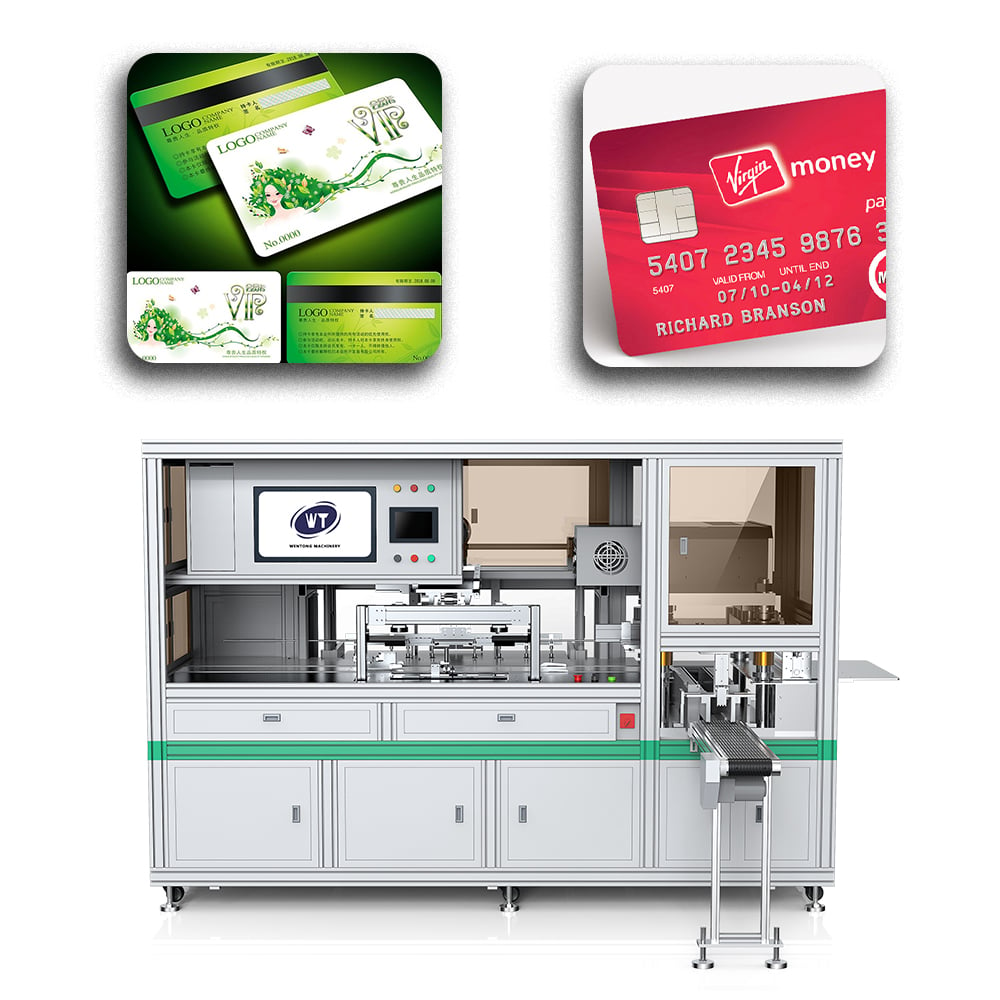
In the card die-cutting process, the tension change in the feeding link, mechanical vibration, environmental temperature and humidity, and other factors are prone to cause cumulative material errors. Traditional mechanical positioning uses baffles and physical sensors, which are difficult to correct micron-level deviations. This means that the punching position is inconsistent with the set pattern, resulting in waste products.
The intelligent bank card punching machine adopts a high-resolution CCD visual positioning system, and its correction method is based on the following technical route:
An industrial camera is set above the feeding platform to take photos of the positioning marks (mark points) on the printed pattern before the material enters the stamping station. The system calculates the deviation values of the three dimensions of horizontal (X), vertical (Y), and rotation (θ) through the real-time image and the pre-stored standard coordinates. The positioning accuracy can reach ±0.05 mm, which is suitable for punching high-precision game cards, animation cards, bank cards, etc.
The control system moves the servo motor according to the deviation data to change the position of the feeding roller or platform. This allows the material position to be corrected in real time. This process is repeated during the feeding process to ensure that the material is always in the correct punching position when it stops. Step feeding technology breaks long-run orders into short-distance, multi-step feeds. This reduces the total error and is best suited for small-batch and multi-batch orders.
For the sake of fixing the registration, the unified die-cutting needs to leave nail holes or connection points on the edge of the material. Although it is easy to remove these holes in the later stage, it is easy to damage the edge of the card. The smart card punching machine adopts a visual positioning system and vacuum adsorption platform to fix the material. There is no physical connection point, and a single card is punched out from the whole material, avoiding burrs and edge damage, and the card edge is better.
The technology enables the bank card punching machine to handle a variety of materials, from paper and PVC film to soft magnetic sheets. This ensures that the position accuracy of the finished product is always the same, which is very important for the next step of hot stamping, lamination, or packaging.
In addition to the initial positioning error, material sliding, mold wear, machine failure, etc. in the production process will lead to an increase in the scrap rate. The intelligent bank card punching machine has a real-time monitoring system, which realizes early warning and automatic adjustment through data analysis and multi-sensor fusion.
Linear sensors and infrared detection devices are installed at the edge of the stamping area to monitor the edge position of the material at all times. If the lateral offset of the material exceeds the limit value (such as 0.1 mm) during continuous feeding, the system will stop and require adjustment. The tension control system also automatically changes the force of unwinding and winding to prevent the material from wrinkling or stretching due to uneven tension.
After a long time of stamping, the cutting edge of the mold will gradually become blunt, and the blanking quality will become worse. The intelligent system monitors the status of the mold in the following ways:
Punching force feedback: The servo punching mechanism tracks the force value required for each punch in real time. When the force value continues to rise (indicating that the blade is blunt) or abnormal fluctuations occur (indicating that the blade is broken), the system will issue a maintenance reminder.
Integrated visual quality inspection: A camera is installed at the exit to scan the edges of randomly selected cards. If the burr rate increases or the cutting is incomplete, the system will automatically associate the number of times the mold has been used with the current state and suggest grinding or replacing the mold.
The control screen displays all monitoring data in the form of charts, including the current production status, the number of defective products, and the efficiency of the equipment. The IoT module can synchronize data to the management end to realize remote monitoring and early warning push. This is great for multinational companies that want to manage all their factories in one place and reduce unplanned downtime.
In 2023, a game card and star card printing company in Mumbai, India, introduced an intelligent bank card punching machine from Shenzhen to replace the old mechanical die-cutting machine. Before the transformation, the factory had the following problems:
The scrap rate has been maintained at around 5% for a long time, especially the loss of high-value animation cards, which is even worse.
When switching orders, the mold needs to be remade and manually adjusted, which takes about 90 minutes on average.
Small orders, such as those for less than 2,000 sheets, are difficult to make money on because the cost of changing the plates is high.
The reason why factories choose smart attendance machines is that they are "short, flat, and fast." The core configuration includes:
7.5 kW servo stamping power, supporting stable punching of soft and hard materials;
High-precision CCD visual correction system can be used with a variety of printing positioning. marks;
The step-by-step feeding module allows you to place orders in small batches.
The lightweight wooden molds (weighing only one-third of the metal molds) can be replaced in 2-3 minutes.
After three months of operation, the production data of the plant is compared as follows:
| index | Before the transformation (mechanical die-cutting) | After the transformation (intelligent card punching machine) |
| Average scrap rate | 5.2% | 0.8% |
| Order switch time | 90 minutes | 15 minutes |
| Delivery cycle for small batch orders | 5 days | 2 days |
| Die change time | 15 minutes (metal mould) | 2.5 minutes (wooden mould) |
| Edge burr complaint rate | 3% | 0.2% |
Visual correction eliminates registration errors: for example, the scrap rate of multi-color printed star cards caused by positional deviation dropped from 3.5% to 0.3%.
Real-time monitoring reduces abnormal losses: material offset alarm, eliminating the generation of waste products; mold status monitoring; timely maintenance of the blade; and the waste rate caused by wear and tear decreased from 1.2% to 0.3%.
Quick mold change: Thanks to the lightweight wooden molds and the preset process parameter database, the factory can handle 8 to 10 different orders every day. This is perfect for the anime card market, which requires quick turnaround.
This case shows that the intelligent bank card punching machine helps card factories to minimize waste and improve the ability to handle small orders by improving accuracy and adaptability.
When printing companies upgrade their equipment, they need to make sure they understand the return on investment (ROI) cycle. For example, if you spend 20,000 on a standard smart card punching machine, you can measure the ROI by looking at how much money you save and how much more efficient you are.
The company produces 2 million cards per month, with an average material cost of $0.03 per card.
The scrap rate dropped from 5% to 0.8%, saving scrap every month:
2 million × (5% - 0.8%) = 84,000
Monthly savings in material costs:
84,000 x 0.03 = US$2,520
The cost of wooden molds is only 40% of that of metal molds, and they can be repaired and polished many times during their service life. The annual investment in molds is reduced by about $3,000.
The auto-tuning and collection system reduced the need for one full-time tuner, saving approximately $50,000 in labor costs per year.
Reducing die changeover time by 75 minutes per day means the company can handle 2-3 small orders, increasing sales by $800 per month.
The company can accept small-batch orders of 500 to 5,000 sheets, with a gross profit margin 15% to 20% higher than that of large-batch orders. The average monthly increase in profits is about $1,000.
Total monthly savings and extra income:
2520+(3000/12)+(12000/12)+1800+2000=8270 USD
2520+(3000/12)+(12000/12)+1800+2000=8270 USD
120000/8270≈14.5 months 120000/8270≈14.5 months
The return on investment is high, as equipment can often be used for more than 10 years. The improved brand reputation (e.g., lower defect rates) and customer loyalty are also difficult to measure, but their long-term value is obvious.
Through the three technical pillars of visual positioning, real-time monitoring, and servo control, the intelligent bank card punching and cutting machine systematically solves the problems of error accumulation, material offset, and mold loss in the card die-cutting process. Data shows that the scrap rate of more than 5% in the industry can be reduced to less than 1%. At the same time, due to its quick mold change (2-3 minutes) and stepping feeding technology, the company can undertake small batch and high value-added orders.

For the printing industry, especially for card manufacturers such as game cards, animation cards, and smart cards, purchasing smart card punching machines is not only a means to improve accuracy but also an important step in the flexibility and digitization of production. Within the 14-18 month investment recovery cycle, companies can not only save money immediately but also make production capacity more flexible so as to cope with the rapid changes in the market and gain a technical advantage over competitors.
 EN
EN