With the development of the global anime economy, limited edition collectible cards (such as anime cards, game cards, celebrity cards, etc.) have become important cultural carriers and derivatives. The value of this card is not just its IP content; it is also more valuable because it is well made and looks good. The biggest challenge faced by card manufacturers, printing companies, and issuing institutions when producing a large number of cards with different designs is to ensure that the products are always the same and the process is always correct. Fully automatic sorting and card punching machines are made into high-end precision production equipment to meet these needs. This article will delve into its main technologies and how it has become an important tool for ensuring consistent card quality control.
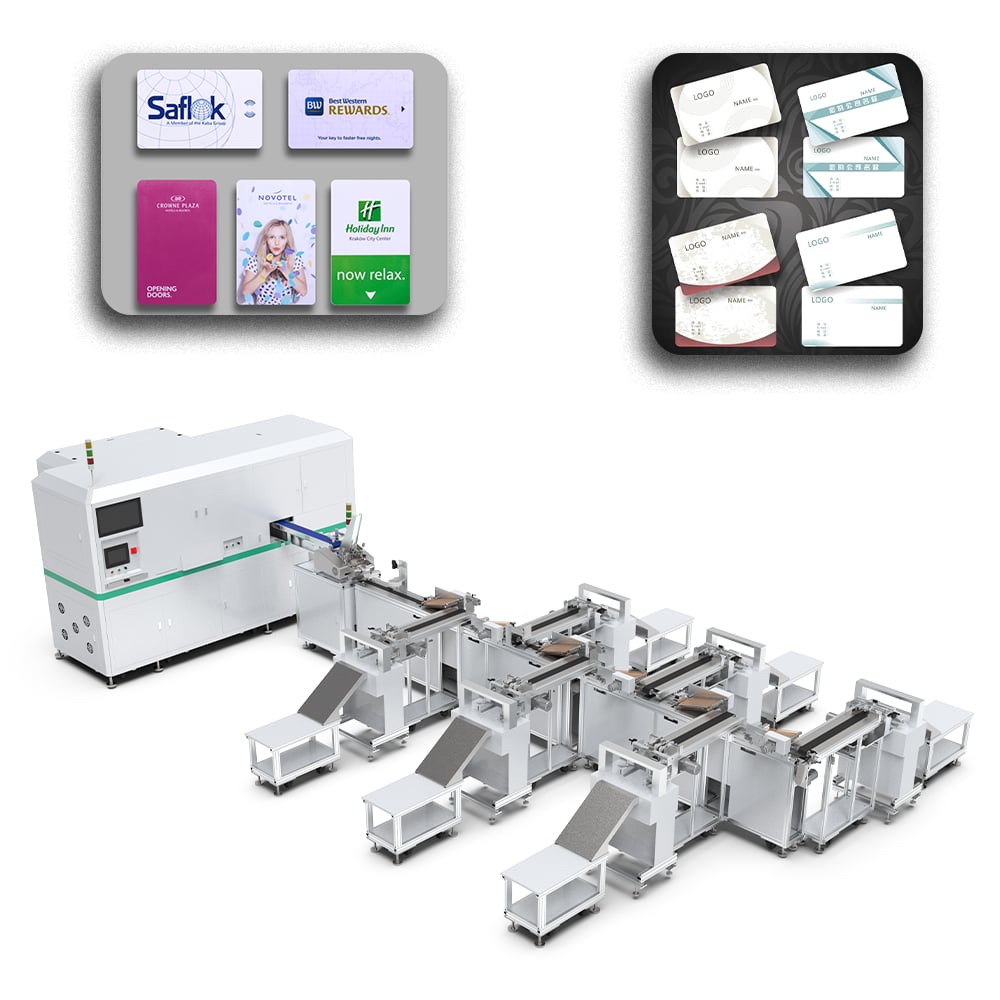
Nowadays, high-end collectible cards often use special techniques to make them look and feel better. Some of them are partial or full-width UV (ultraviolet varnish) coatings, hot stamping, embossing, and complex irregular cutting (non-right-angled rectangles, such as rounded corners, contour cutting, etc.). These steps not only give the card its own value but also make it difficult to cut and classify it in the future. When processing cards with UV coating or textured surfaces, traditional equipment often experiences feed slip, positioning errors, and die-cutting deviations due to uneven coating thickness, different reflected light, or changes in friction coefficient. But for irregular cutting work, the cutting mold and printing pattern must be very, very close. Even a small misalignment can damage the final product.
The fully automatic sorting and card-punching machine solves this problem by adding a high-precision layout visual correction and positioning system. Its working principle is to take and recognize photos, compare them with reference points, and perform dynamic correction. The most important part of the feed path is an industrial-grade high-resolution CCD camera. This camera can quickly take photos of each card that is about to be sent to the die-cutting station. The software of the system saves the standard layout of the cards and adds special optical recognition marks, such as crosshairs, corner marks, or pattern features. Then, the visual system tracks the position of the marker on the current card in real time. The system uses the difference between the actual marking and the standard position (including X and Y axis translation and rotation angles) to calculate the amount of card movement on the conveyor platform. Then, it uses a very precise servo adjustment mechanism to ensure perfect alignment between the card and the lower mold. The visual system uses specific wavelengths of light and filters to reduce glare and ensure clear and easily recognizable markings. This is because UV coating causes light to bounce off objects. This technology allows you to place things where you want, even on high-gloss UV or partially heavy embossed cards on the entire page. This is because it perfectly adapts to the cutting path of uneven blade molds and ensures that the edge craftsmanship of each card is exactly the same as the design sketch.
When making limited edition cards, there are usually varying degrees of rarity, such as regular cards, rare cards, flashcards, signature cards, etc. These cards are printed on the same paper but arranged in a staggered manner. After die-cutting, it is necessary to classify and assemble in the correct way for future packaging and sales. Manual sorting takes a long time and often makes mistakes. On the other hand, fully automatic sorting and clocking machines use intelligent sorting paths and rare coding systems to quickly sort without errors. Some of its main technical processes include binding and identifying information, online scanning and decoding, and intelligent path allocation. Before making cards, the printing process can print invisible or specific microcodes (such as numerical codes, barcodes, or visual features related to the surface pattern of the card) on the blank edges of each card or card slot. The encoding information is exactly the same as the rarity of the card and is pre-inserted into the control system of the punch-in machine. After the die-cutting unit completes punching, the independent cards are sent to the sorting module. This module has a quick code reader or an additional visual recognition unit that can quickly read the encoded information on the card as it moves. The control system uses rare information obtained from decoding to inform the high-speed electromagnetic separator or robotic arm in real time to send the card to the correct collection channel. The whole thing is progressing quickly and makes sense.
The gradual and precise feeding technology of this device ensures that each card is in a separate workstation, which can be controlled during die-cutting and sorting processes. This can prevent cards from squeezing or colliding with each other, which is very important for protecting the corners and surfaces of precious and rare cards. There are two ways for this device to collect finished products: in order, to maintain the production order of the cards for easy searching and matching; Classify them by category and place them in different storage boxes based on their rarity. This enables the next generation of automated packaging lines to produce materials in real time in bulk. This finished product has high positional accuracy and good edge quality sorting. This means that even ultra-thin or special material cards, such as coated paper cards or PET films, can look flawless without any burrs or scratches.
In order to maintain popularity, the anime-restricted card market needs new series and themes. That's why most production orders are for "small batch, multi-variety" products. In this case, traditional large-scale die-cutting machines are not efficient because it takes a long time (usually several hours) to replace the mold and set up the machine. This reduces production efficiency and extends delivery time. The concept behind fully automatic sorting and clocking machines is "short, flat, and fast." The best way to manufacture small-batch limited-edition products is through their fast conversion technology. The first sign of this solution is that it uses lightweight wooden molds that can be quickly replaced. These tools use lightweight and highly precise wooden knife molds. Wooden molds are lighter, cheaper, and require less production time compared to heavy metal molds. The patented quick clamping mechanism allows one person to safely disassemble the entire set of knife molds and lock the installation of new molds within 2-3 minutes. This reduces the waiting time for devices.
Secondly, the ability to quickly modify orders and make changes to machines is another significant advantage. The main changes required when switching between card production of different sizes or layouts are the positioning and blocking rules of the feeding platform, the partition settings of the receiving platform, and the template switching of the visual system. Skilled operators can switch between products and repair them in approximately 15 minutes, including recalibrating visual positioning benchmarks, thanks to touch screens and parametric programming. This device can also handle many different materials and is easy to sample. It can be used with cardboard, copperplate paper, PET, and PVC. Soft magnetic sheets are used together with other types of paper and film soft magnetic sheets. Its precise step-by-step feeding system keeps thin and warped materials stable, making it highly suitable for large-scale production and sampling. Before starting large-scale production, customers can conduct small-scale trial production to ensure that the molds, processes, and materials work properly. This greatly reduces development risks.
Finally, the machine adopts the latest die-cutting technology and has a high-power servo stamping power of 7.5 KW, which can immediately provide strong and stable cutting force. When used in conjunction with precision mechanical structures, it can eliminate nails or other connection points in die-cut products. Traditional craftsmanship has added connection points in the design to prevent products from scattering after die-cutting. Afterwards, you must tear it by hand, which takes longer and may damage the product. This device does not require a connection point, as it has a precise suction, positioning, and collection system. This means that the final product has clean, sharp edges, no additional steps in the processing, and better quality. This device can also make the overall solution of connecting backend product packaging larger. After die-cutting and sorting, the cards can be directly connected to automatic bagging, boxing, labeling, or packaging machines through conveyor belts. This forms a small and efficient continuous production line, further shortening the time between manufacturing and packaging.
In the anime collectible card market, quality and quick response are the most important things, and the accuracy, flexibility, and intelligence of production equipment directly affect the competitiveness and popularity of products in the market. The fully automatic sorting punching machine utilizes its core layout visual correction and positioning technology to solve the high-precision problem of die-cutting special process cards. The intelligent sorting system with rare encoding makes it possible to quickly and accurately sort complex and difficult-to-sort mixed boards. The revolutionary fast conversion technology (mold replacement takes 2-3 minutes, and order switching takes about 15 minutes) is very suitable for the "small batch, multi-batch" limited edition production mode. Data shows that printing companies using these high-tech machines can shorten the conversion time for small batch card orders by over 70%, increase the one-time yield rate of finished products to over 99.5%, and make sorting speed over 300% faster than manual labor. This not only saves a lot of labor and production costs but also ensures that every limited edition card obtained by collectors has perfect and very consistent physical quality. This is crucial for the steady growth of intellectual property value and the collective economy. Printing and card-making companies that want to establish core production capacity advantages in the global market, especially in places like India where the card market is large and growing rapidly, should definitely invest in these technologically advanced "short, flat, and fast" production tools.

 EN
EN