In the collectible card business, quality control has never been a cost issue; it's always about being alive. If a card has small burrs on its edges, is more than 0.1 millimetres away from the punching position, or has uneven corners, collectors call it a "scrap card". In the past few years, the Indian anime card market has grown rapidly. Many OEM orders for IP authorisation cards from Japan, Europe, and the United States are fulfilled by local printing companies. Card manufacturers are increasingly not accepting cards with visual defects. The traditional die-cutting process has three main structural problems: firstly, the design of nail positions and connection points requires waste edges to be left between the cards. After die-cutting, the connection points must be torn open by hand, which is the main cause of card edge wear; Secondly, thin materials such as thin films and soft magnetic thin films may undergo slight movement during the feeding process, which may cause image cutting to deviate from the centre; Thirdly, decorative layers such as hot stamping and holography are highly sensitive to physical contact, and traditional mechanical claws always leave indentations when grasped. The technical design of the fully automatic sorting and card-punching machine aims to solve the above problems. People often use this machine to make cards, such as business cards, game cards, anime cards, bank cards, celebrity cards, etc. Its main advantage is that it makes the entire process of precise feeding, automatic collection, and waste removal easier and also improves the edge quality of finished cards to the "collection level" standard.
From a technical perspective, the industry considers visual deviation within 0.10 mm as passing through the line. But this tolerance may still cause the light distortion pattern to move on the surface of the hot stamping or holographic card. We need to change the stamping time, mechanical gearbox, and visual positioning so that they work together in a closed-loop system. The reason is that our control target is set at 0.05 mm. The fully automatic sorting and clocking machine is manufactured for the Indian market, with many different orders and small batches. It has a precise feed mechanism that can work step by step, as well as visual correction and positioning functions for layout. Therefore, you can replace a machine in less than 15 minutes. Replacing lightweight wooden moulds only takes 2 to 3 minutes, making the production mode "short, flat, and fast". The device is also equipped with a 7.5 kW servo motor to control the cutting power, so it can cut thick and thin materials with one knife without leaving any burrs. This provides a hardware-level guarantee for printing companies, as they can handle orders for high-end collectible cards.
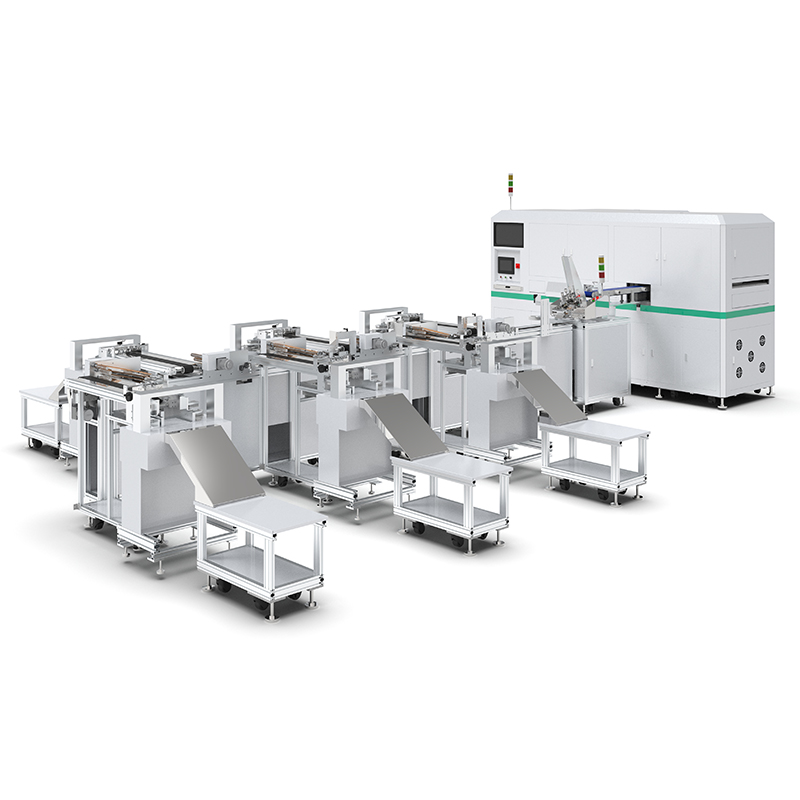
The first technical obstacle to quality control of collectible cards is not punching holes, but "accuracy of observation position". Traditional die-cutting machines use mechanical positioning pins or cursor tracking. When adding an emergency stop to the servo motor, the positioning error is usually between ± 0.15 and 0.20 millimetres. The response of the photoelectric sensor to the printed colour code takes approximately 5-10 milliseconds. For layout boards (such as 5 × 5 or 4 × 8), the cumulative error in edge position will be greater. The fully automatic classification and sorting punch-in machine adopts high-resolution industrial cameras and sub-pixel contour detection algorithms, completely changing the working mode of positioning. The first step of global coarse positioning: the equipment automatically loads materials through the tray, and the suction cup uses a shaking suction mechanism to ensure no repetition. When the paper reaches the visual workstation, the camera will take a photo of the entire circuit board. It uses alignment marks on the four corners of the board to calculate the overall offset and rotation angle. Then, it fixes the coordinate system for the entire circuit board, not just a card. The system uses design files sent by customers to create theoretical coordinates for each die-cutting target. This is the second layer of local precise positioning. The sub-pixel algorithm fills in the greyscale gradient between pixels, increasing the edge localisation resolution from 1 pixel to the 0.1-0.2 pixel level. The system can see contour offsets as small as 0.01 mm, even with a camera pixel size of 5 million. One of the best things about the Indian market is that you can place small batch orders. It takes over 30 minutes to calibrate traditional equipment every time the board is changed. On the other hand, this machine has a progressively precise feed system with servo screw modules that can feed sequentially. Real-time visual feedback can determine the duration of each feeding step. When the temperature and humidity change, the batch shrinks by 0.02%, and the system automatically shortens the feeding distance. This ensures that the finished product of the 100th card is as accurate as the first card.
The engineering advantage of this algorithm is that it allows customers to use conventional four-colour printing machines to make cards without having to purchase expensive alignment cursor spot colour plates for die-cutting. This saves a lot of money for sampling. The fully automatic sorting and clocking machine is even better, as it can easily switch between offline sampling and batch production. Customers can take die-cutting samples of small batches of materials before placing an order. This allows them to check visual accuracy before starting mass production. Traditional equipment has the problem of "accurate sampling and poor mass production", but this completely solves this problem. Actual data from several inkjet printing factories in India shows that the use of sub-pixel positioning technology has reduced the image offset defect rate in large-scale production from over 3.5% in traditional equipment to below 0.5%. The consistency error from sampling to mass production is also maintained at ± 0.03 mm. This provides strong technical evidence for brand factory audits.
Some methods to make collectible cards more valuable are hot stamping numbers, holographic anti-counterfeiting labels, and UV relief varnish. All of these places have the same problem: they cannot handle scratches, pressure, or friction. In order to collect finished products, traditional automatic punching machines use lever pushing or belt clamping. Therefore, many people are dissatisfied with the thin white lines drawn on the hot stamping layer. The card punching and sorting machine that works completely independently has two unique sorting methods: air floating guide rail and flexible silicone suction cup array. When we use flexible suction cups, it's not just about replacing materials; This has also changed our perception of 'grasping'. The diameter of each suction cup is only 3 millimetres, and the contact pressure is less than 0.05 N/cm². They are arranged like a honeycomb, each with its own air path to control it. When the suction cup comes into contact with the hot stamping surface, the air pressure sensor will monitor the sealing degree of the suction nozzle on the card surface in real time. When a leak is detected (because the hot stamping pattern will make the surface uneven), the suction cup next to the leak will automatically switch to compensate for the leak, rather than making the negative pressure stronger. This allows you to lift the card through 3D hot stamping without damaging the relief texture.
Air-floating guide rails can prevent cards from being damaged due to friction during sorting and movement. The standard card slot features a baffle-style stacking system that slides between the edges and sidewalls, as well as between card surfaces. At the bottom of each sorting channel, the device has a microporous chamber that is always pressurised with a low pressure of 0.3-0.5 kg. This keeps the finished product card in a micro suspended state of 0.1 mm during the discharge process. The card will not directly contact the metal guide rail, and the holographic layer will not wear out. Using traditional equipment, the "surface process defect rate" in mass production has increased from 1.8% to 2.5%. After adopting the air flotation collection scheme, its content decreased to below 0.3%. This means that for every 100000 cards with a single added value exceeding $2, you will save nearly $4000 in scrap losses. This design also enables the fully automatic sorting and punching machine to process various materials such as paper, film, and soft magnetic sheets without changing the air path settings when switching materials. This indeed makes it possible for 'one device to be used for various cards'.
In the world of collectible cards, "limited edition numbered cards" are always the most expensive. In the secondary market, a rare card with a serial number of 1/100 and an independent hot stamping number can be sold for tens of times more than a regular card. But in this industry, making number cards is a well-known technical minefield. It is important to check whether the numbers from 1 to 100 are arranged in the correct order and whether the hot stamping numbers on each piece of paper are easy to read and positioned correctly. Traditional craftsmanship starts with hot stamping numbers and then die-cutting. However, there is a big problem: when the paper arrives at the die-cutting station, it cannot be guaranteed that each card is in the same position. The cutting knife may cut off the edges of the numbers, which means that the entire batch of numbers must be discarded. For limited edition production, the fully automatic sorting and punching machine has proposed an architecture of "packaging linkage after sorting". The most important part is not the punching itself but the real-time mapping and manual sorting of the read numbers. The process is as follows: the standard card shape is made using traditional die-cutting (at this time, the cards have not yet been heat stamped with numbers and are semi-finished products) → the cards enter offline or online hot stamping stations, where they are numbered and hot stamped one by one (the system gives each card a virtual ID before entering the hot stamping station and controls the relative accuracy between the hot stamping position and the die-cutting contour within ± 0.10 mm through servo positioning) → the hot stamped cards are sent to the sorting unit of the equipment. The high-speed industrial camera reads the hot stamping digital characters on the card at a speed of 10 to 15 per second and uses an OCR algorithm to convert the image into a sequence of numbers. The control system tells the sorting finger to send the card to the right card slot based on the read number. For example, 1-10 enter slot A. From the 11th to the 20th, enter slot B, where you can place each card in its own position.
The best part of this plan is that you no longer need to manually organise the cards. According to the old production method, three people sitting around the table must select, sort, and pack one hundred die-cutting cards in numerical order. This takes 15 to 20 minutes and is prone to errors. The device completes all of these tasks on its own through automatic sorting. Sort 100 cards in no more than 40 seconds, and 99.99% of the time it is correct. The fully automated sorting and clocking machine is even better, as it works together with the backend connected to the overall packaging solution. This means that the sorted cards do not need to be moved before entering the automatic bagging machine or plastic sealing machine directly. This means that the entire process from cutting moulds to sorting and packaging can be completed without the help of anyone. This device has two ways of collecting finished products: classified collection and sequential collection. This is because the demand for "small batch, multi-version" limited edition card orders in the Indian market continues to grow. The first type is suitable for sorting and packaging mixed cards, while the second type is suitable for cards that are numbered one by one. The card-receiving unit has a structure for rotating or parallel robot grasping. It can hold 500 sheets of paper in one box, and you can add more boxes to accommodate 1200 workstations. Local Indian printers can handle large orders from major IP companies around the world, as they can continuously obtain cards from 1 to N.

Creating collectible anime cards is more like making something that is precisely measured than printing something. The fully automatic classification, sorting, and card-punching machine is a technological breakthrough that can be measured in five different ways in the industry. The visual positioning system based on the sub-pixel contour algorithm locks the batch cutting tolerance within ± 0.05~0.10 mm, which is the highest level allowed by the ISO CR-80 international standard. Compared to old devices, this reduces the number of image offset defects by 82%. The 7.5 kW high-power servo direct drive cutting unit and twin-screw alternating feed system work together to stabilise the production speed at 20000 to 35000 sheets per hour. The quick replacement mechanism for lightweight wooden moulds is more important because it makes it easier to switch orders. Replacing the mould only takes 2 to 3 minutes. Debugging the entire machine's order switching only takes 15 minutes. This makes short, flat, and fast small-batch agile production possible. Material Adaptability Index: Machines that can handle many different materials, such as paper cards, PVC, PET, ABS, soft magnetic sheets and mixed materials. They are particularly adept at solving the feeding deviation problem that occurs when thin film materials stick together due to static electricity. You can use the feeding structure to set the length of each single-step feeding, so you don't have to customise the feeding roller for each product. Finished product quality indicators: The non-destructive sorting design keeps the edge burr rate below 0.1%, and the combination of flexible suction cups and air-floating guide rails ensures a surface integrity rate of over 99.7% for hot stamping/holographic card surfaces in automated production. Three years ago, people still believed that fully automated machines could not surpass this technological limit. Post-integration indicator: The equipment has been upgraded from a single machine to a major node in the "die-cutting, sorting, and packaging" process chain. It can communicate with automatic packaging lines and palletising systems, helping customers save 70% of backend labour costs. The Indian business card printing market is shifting from "low-priced bulk" to "boutique collection". For factories that want to accept international collectible card orders, it is no longer just a matter of selecting suitable tools. They need fully automated machines for sorting, sorting, and punching, which can provide visual feedback, locate things at sub-pixel levels, sort without damage, and automatically sort.
 EN
EN